Window Tinting in Sacramento, CA — Ceramic Film, Priced by Vehicle
· Updated
Ceramic window tint is a nano-ceramic film that blocks up to 99% of UV rays and rejects a large share of solar heat — without using metal, so your phone, GPS, and keyless entry keep working. In Sacramento's heat, that means a cabin that stays cooler, an interior that does not fade and crack, and film that won't turn purple in a few years like cheap dyed tint does.
We are Art Printing Vehicle Wraps at 5051 College Oak Dr. We install ceramic tint the same way we do everything else — premium film, in-house install, and a price we tell you up front. If you have been burned by bubbling, peeling, purple bargain tint before, this is the opposite.
Start a free estimate · (916) 532-1891
Ceramic window tint in Sacramento is $175 for the two front windows, $450 for a full sedan or $550 for a full SUV (all glass except the windshield), and $650 for a Tesla or EV package. Ceramic film rejects infrared heat without the signal interference metallic tint causes, and every install is cut to California's front-window tint limits.
Why ceramic — and why it matters more in Sacramento
Not all tint is the same film with a different price. The cheap stuff is dyed — it darkens the glass and does little else, then fades purple and starts bubbling within a few years. Ceramic is a different technology, and in this climate the difference is the whole point.
- Up to 99% UV rejection, per the film makers' published specs. Blocks the UVA and UVB that age your skin on a long commute and bake your dashboard. It protects you and the interior at the same time.
- Real heat rejection. Ceramic rejects a large share of solar heat, so the cabin stays cooler in full Central Valley sun and your air conditioning works less. You feel it most on a dark-interior car that sits outside in July.
- No signal interference. Older metallic tints could choke cell signal and GPS. Ceramic has no metal, so your phone, navigation, satellite radio, and keyless entry are unaffected.
- Clarity and glare control. Even at darker shades, ceramic keeps crisp day-and-night visibility and cuts glare from sun and oncoming headlights.
- It lasts. Premium ceramic film holds its color instead of going purple, so it looks right for the long haul.
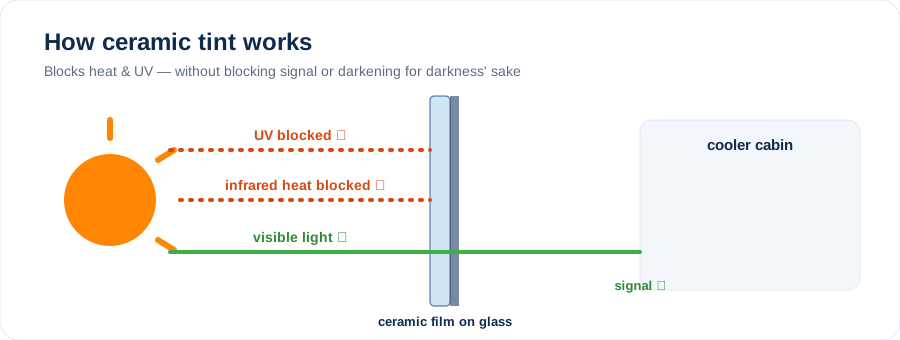
In a place where summer cabin temperatures regularly climb past anything comfortable, heat and UV rejection are not luxuries — they are the reason to tint at all.
Ceramic tint prices by vehicle
Most shops make you call for a tint price. Here is ours, in full. These are the real numbers for ceramic film, not a teaser rate that grows in the bay.
| Service | Price | Notes |
|---|---|---|
| Front two windows | $175 | The comfort upgrade — legal shade, real heat rejection |
| Full sedan — all windows except windshield | $450 | Front pair, rear sides, rear glass |
| Full SUV / crossover — all windows except windshield | $550 | More glass, larger curved rear |
| Windshield sun strip | $75 | Legal top-four-inch glare band |
| Tesla / EV package | $650 | Large one-piece rear glass, shrunk to shape |
| Old tint removal | From $75 | Depends on film age and which glass |
We install ceramic. In a climate where a car bakes in a parking lot from May to October, paying twice for dyed film — once now and once when it turns purple — costs more than doing it right once.
Why tint quotes differ between shops:
- How many windows. Two front windows is the entry job. A full vehicle is every piece of glass, and vehicles differ by several windows.
- Glass shape. Steeply curved rear glass takes far longer to shrink and fit than a flat door window. Large one-piece rear glass — Teslas, most SUVs — is the slowest panel on the car.
- Old film coming off. Removing failed tint is its own labor, and it is the step that gets rushed elsewhere. Rear glass has the defroster grid printed on it, and careless adhesive removal takes those lines with it. We price removal honestly rather than pretending it is free.
Comparing quotes from other shops? Our guide to window tint prices in Sacramento shows how to line two quotes up so you are comparing the same glass and the same film.
Tint pairs naturally with the rest of what we do. Many customers add it to a Tesla or EV wrap, or book it alongside a ceramic coating and an auto detail so the car leaves protected inside and out.
Dark does not mean cool — the number most shops never mention
This is the single most useful thing to understand before you pick a shade.
VLT measures how much visible light gets through — how dark the glass looks. TSER — total solar energy rejected — measures how much of the sun's actual energy the film keeps out. They are different numbers, and they are not tied together.
A cheap dyed film at a very dark shade looks aggressive and does almost nothing about heat. A quality ceramic film at a legal, nearly clear shade can reject substantially more solar energy than that dark film does. Darkness is a styling decision. Heat rejection is a materials decision.
That is why we can keep your front windows street-legal and still make the cabin noticeably cooler: the work is done by the film, not by the darkness. Ask any shop for the TSER figure on the film line they are quoting. If they only talk about how dark it goes, you have learned something.
Car window tint options and CA tint-law compliance
"Car window tint in Sacramento, CA" covers a range of shades and film lines, and the right one depends on how dark you want to go and what the law allows. The shade is measured as VLT — visible light transmission, the percentage of light the film lets through. Lower VLT means darker glass.
Here is the part most bargain shops skip: California regulates how dark you can legally go, and a ticket for illegal tint costs more than doing it right.
- Front side windows: must let in at least 70% of light (70% VLT).
- Windshield: a tint strip is allowed on the top four inches.
- Rear window and back side windows: any darkness you like.
- Side mirrors: if the view through your rear window is obstructed — by dark film, a window graphic, or cargo — California requires the vehicle to have both a left and a right side mirror.
| Glass | California limit, passenger vehicles | What we usually install |
|---|---|---|
| Windshield | Tint strip on the top four inches only | Ceramic sunstrip for glare |
| Front side windows | Must transmit at least 70% of light | Legal-shade ceramic — heat rejection without the ticket |
| Rear side windows | Any darkness | Your choice of shade |
| Rear window | Any darkness, provided the vehicle has both side mirrors | Your choice of shade |
Two more rules worth knowing. California prohibits red and amber tint, and restricts mirrored or metallic-looking film on the front sides — so the shade you want has to come from a film that is legal to put there in the first place. And the state does allow a medical exemption for darker front glass with a signed letter from a licensed physician or optometrist; if sun sensitivity is the reason you are tinting, that is a conversation worth having with your doctor before you pick a shade.
The good news: ceramic film does its heat and UV work at any shade. You do not need to go dark and illegal up front to stay cool — a legal, light ceramic film on the front glass still rejects heat and UV. Go darker on the rear where the law allows it.
Install day, and the three days after
Tint goes on the inside of the glass, so the shop needs the vehicle, not just the windows. A typical car is a few hours; a full vehicle with large curved rear glass takes longer.
Then the part nobody warns you about: the film is applied wet and cures as that moisture evaporates.
- Leave the windows up for several days. Rolling a window down before the film has bonded is the most common way a fresh tint job gets ruined — and it is not a warranty claim, it is gravity.
- Slight haze or small water pockets are expected. They clear as the film dries. Sacramento heat works in your favor here; curing is faster in summer than in a damp winter week.
- Do not clean the inside of the glass until it has fully cured, then use an ammonia-free cleaner. Ammonia degrades tint film.
- Small specks are worth a second look. Dust happens in any install; if something bothers you after the film has cured, bring it back and we will look at it.
Film warranty and workmanship
Two separate things, and shops blur them on purpose.
The film's warranty comes from its manufacturer and typically covers bubbling, peeling, cracking, and color change. Ask which film line you are getting and what its warranty actually says — a shop that will not name the film is telling you something.
The workmanship warranty is ours: we back our installs with a 60-day workmanship warranty, the same as our wrap work. If something we did is wrong, we make it right.
Buildings, not just vehicles
Vehicle tint happens in our shop — film needs a clean bay and controlled temperature, and dust picked up in a driveway ends up permanently under it. Commercial glass is the exception: for offices, storefronts and conference rooms we bring the work to your building. Solar film for heat and glare, security film that holds glass in the frame, frosted privacy film with your logo cut into it. See commercial window tinting.
Looking for window tinting near you in the Sacramento area?
We are at 5051 College Oak Dr, Suite C in Sacramento and tint vehicles from across the metro — Roseville, Folsom and the rest of our service area. Tint is one of the few jobs where the drive is worth it: the film and the hands doing the install decide the result and both outlast the trip.
Frequently asked questions
What is the difference between ceramic tint and regular tint?
Regular dyed tint just darkens the glass and fades purple in a few years. Ceramic uses nano-ceramic particles to block up to 99% of UV and reject far more heat, with no metal to interfere with signal. It costs more up front and earns it back in comfort and durability.
How dark can I legally tint my windows in California?
On a passenger vehicle, the front side windows must let in at least 70% of light. A tint strip is allowed on the top four inches of the windshield, and the rear and back side windows can be any darkness. We install to keep you compliant.
Does ceramic tint really keep the car cooler?
Yes, noticeably. It rejects a large share of solar heat, so the cabin stays cooler in full Central Valley sun and your air conditioning works less. You feel it most on a dark-interior car parked outside all day.
Will ceramic tint block my phone or GPS signal?
No. Ceramic has no metal, so it does not interfere with cell signal, GPS, satellite radio, or keyless entry — unlike older metalized films.
How much does ceramic window tint cost in Sacramento?
$175 for the two front windows, $450 for a full sedan, $550 for a full SUV — all glass except the windshield. Tesla and EV packages are $650; a windshield sun strip is $75. Ask about a combined estimate if you are also wrapping or detailing.
How long does a tint install take?
A typical car is a few hours. A full vehicle with large curved rear glass — Teslas, most SUVs — takes longer, because that glass has to be heat-shrunk to fit a compound curve. We book it as a same-day job and tell you the realistic pickup time up front.
Why can't I roll my windows down afterward?
The film is applied wet and bonds as that moisture evaporates. Rolling a window down before it has cured drags the film off its edge. Leave the windows up for several days — in Sacramento summer heat, curing is on the fast end of normal.
My new tint looks hazy and has little water pockets. Is it defective?
Almost certainly not. Haze and small pockets are the curing moisture, and they clear on their own as the film dries. If something is still visible after it has fully cured, bring it back and we will look at it.
Can you remove my old, bubbling tint?
Yes, and it is a real job rather than a free add-on. Rear glass has the defroster grid printed on the inside surface, and rushing adhesive removal there is how those lines get destroyed. Removal starts at $75 and is quoted as its own line.
Does darker tint mean cooler?
No — that is the most common misconception in this whole category. Darkness is VLT; heat rejection is TSER, and they are separate numbers. A legal, nearly clear ceramic film can reject more solar energy than a dark dyed film. Ask for the TSER figure, not just the shade.
Can I get my front windows darker than 70% in California?
Not on a standard passenger vehicle. The state does allow a medical exemption with a signed letter from a licensed physician or optometrist — if sun sensitivity is your reason for tinting, that is worth raising with your doctor first. Otherwise we install to the legal shade and let the film do the heat work.
Will tint work on my Tesla's big rear glass?
Yes, and it is one of the jobs that most rewards a good installer. That glass is one large compound curve, so the film has to be shrunk to shape before it goes on. Our Tesla / EV package is $650 — see Tesla and EV wraps if you are considering both.
Should I tint before or after a wrap?
Either order works, since tint goes inside the glass and wrap film goes on the paint. Booking them together is usually cheaper and costs you one drop-off instead of two.
What warranty comes with the tint?
Two separate things. The film carries its manufacturer's warranty — typically against bubbling, peeling, cracking, and color change; ask us which line you are getting and what it covers. Our own workmanship warranty is 60 days, the same as our wrap work.
How do I clean tinted windows?
Wait until the film has fully cured, then use an ammonia-free cleaner and a soft cloth. Ammonia attacks tint film and will haze it over time — which is why a lot of older tint looks cloudy long before its time.
Ready to stop cooking in the Sacramento sun? Get a free estimate and we'll send a real, street-legal tint price for your exact vehicle.
5051 College Oak Dr Suite C, Sacramento, CA 95841
Phone: (916) 532-1891
Hours: Monday–Friday, 9:00 AM – 6:00 PM